Replace repeated verbal guessing with a touch-first reference that helps learners locate oral placement more clearly.
Created for pediatric clinicians
A clearer, hands-on way to teach mouth placement in pediatric speech therapy.
Tactile tools created by SLPs and clients for multisensory support, helping clinicians show, explain, and reinforce oral placement with more clarity for learners and caregivers.
Co-designed by SLPs and clients
Accessible by design
Built for caregiver carryover
Reserve early access for the first clinician release
Join the early-interest list for educator pricing, launch timing, and first access to the tactile tool and companion materials.
Low-friction early access
No spam
Educator pricing updates
Launch timing + first access
Prototype preview
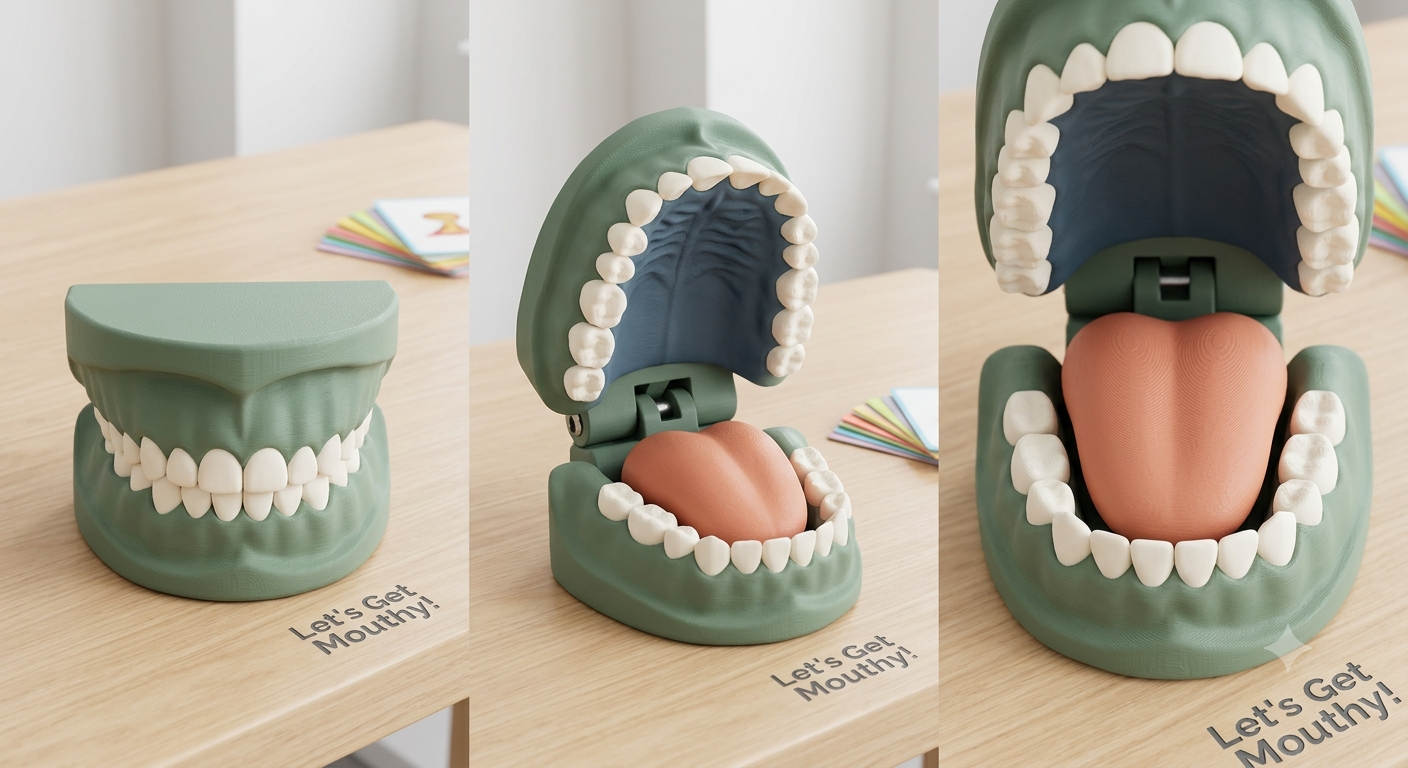
A tactile mouth model with open-close positioning, textured palate cues, and clearer landmarks for multisensory teaching.
Built to support visually impaired, DeafBlind, and multisensory learning contexts without relying on visual-only explanation.
Give families and school teams a cleaner shared reference so practice feels more consistent beyond the session.
Product Demo
How it helps in sessions
The tool supports a simple rhythm in practice: show the target, let the learner feel the landmark, then reinforce the same language beyond the session.
Textured palate and clear landmarks
The current prototype highlights the roof of the mouth, open-close positioning, and the key physical landmarks clinicians reference during teaching.
Step 1
Show
Use the model to point out teeth, palate, and tongue space with more precision than a verbal explanation alone.
Step 2
Feel
Let learners trace tactile landmarks so oral placement becomes something concrete, not abstract.
Step 3
Reinforce
Use the same visual and placement language with caregivers so practice carries into home and school routines.
Why Clinicians Use It
Benefits that support faster teaching, clearer understanding, and stronger follow-through.
Mouthy is built to make teaching clearer in the moment and carryover easier after the session ends.
Spend less time re-explaining where the sound happens.
Physical landmarks help clinicians model target placement faster and more consistently.
- Use case: Introduce a target without vague verbal cues.
- Result: More time practicing and less time building a mental picture.
Turn abstract oral placement into something students can see and feel.
The model supports learners who benefit from tactile structure and repeated concrete reference points.
- Use case: Support visually impaired, DeafBlind, or highly tactile learners.
- Result: Better understanding of where the target happens in the mouth.
Create a shared visual language that families and teams can actually use.
A cleaner reference makes it easier to explain goals to caregivers, teachers, and support providers.
- Use case: End a session with a handoff that feels simple and specific.
- Result: More consistent practice across home, school, and therapy settings.
Where It Fits
Built for real pediatric settings where visual clarity and tactile teaching both matter.
Each use case shows who the tool supports, what challenge they face, and how it helps in practice.
School-based SLPs
Busy caseloads need faster, clearer demonstrations.
School-based SLPs
Busy caseloads need faster, clearer demonstrations.
- Role: Pediatric clinicians working across multiple students and goals.
- Challenge: Limited time to re-explain oral placement with words alone.
- Support: A repeatable tactile and visual reference that speeds up modeling.
Private practice
Family communication needs to feel polished and easy to follow.
Private practice
Family communication needs to feel polished and easy to follow.
- Role: Pediatric private practice clinicians and clinic owners.
- Challenge: Explaining targets clearly enough for caregivers to remember later.
- Support: More confident caregiver education and a stronger premium experience.
Accessible learning
Some learners need more than visual-only instruction.
Accessible learning
Some learners need more than visual-only instruction.
- Role: Clinicians serving DeafBlind and visually impaired learners.
- Challenge: Typical visual prompts do not offer enough tactile access.
- Support: Tactile cues and Braille-ready concepts support a more accessible teaching path.
Articulation and multilingual support
New or unfamiliar targets need a clearer physical reference.
Articulation and multilingual support
New or unfamiliar targets need a clearer physical reference.
- Role: Clinicians supporting articulation therapy and multilingual learners.
- Challenge: Learners may struggle to compare new placements with familiar ones.
- Support: Makes differences in placement easier to show, feel, and revisit.
Beyond the Tool
Support beyond the session with a companion ecosystem that keeps teaching consistent.
The curriculum portal extends the physical model into lesson plans, shared placement language, and home reinforcement materials that connect back to the same tactile reference.
Session
Model and teach
Introduce oral placement with the same landmarks and cueing language used on the physical tool.
Handoff
Share with caregivers
Use structured take-home language so families understand what they saw in session.
Home practice
Reinforce consistently
Printable supports and lesson materials help practice feel familiar instead of starting over.
Reserve early access
Help validate the first release and join the early-interest list for educator pricing, launch timing, and first access to the tactile tool and companion materials.
No spam. Just launch timing, educator pricing, and early access details.
Best for pediatric clinicians who want clearer placement teaching, stronger caregiver
follow-through, and a more polished multisensory teaching experience.